
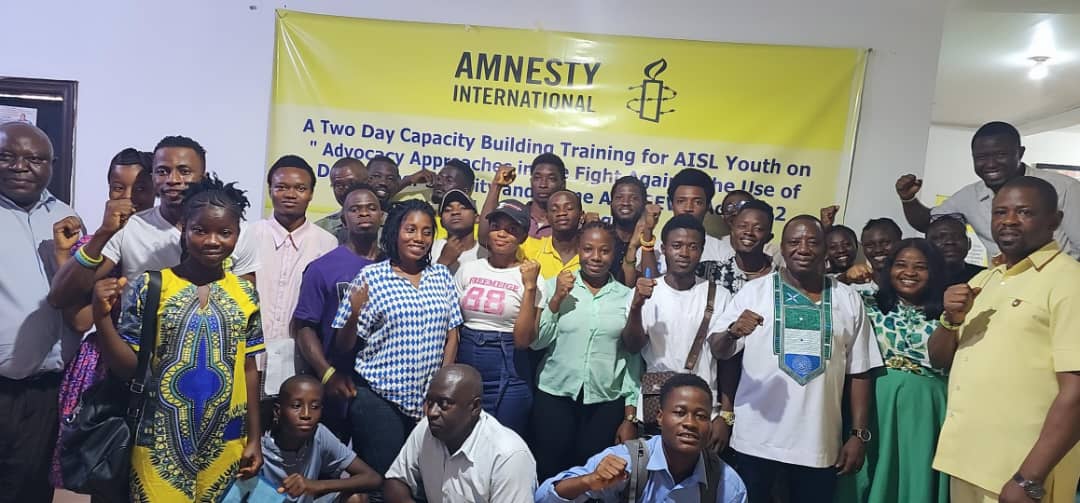


Amnesty International Sierra Leone (AISL) has concluded a highly engaging two-day capacity building training workshop for its youth constituency, held from 13th to 14th November 2025 in Freetown. The workshop was developed in response to capacity gaps identified by young members across the movement, aimed at enhancing their competencies in advocacy, campaigning, and meaningful human rights engagement at community and national levels.
The training brought together 34 participants, including 22 young people and 12 representatives from activists, interns, and partner organisations, drawn from different regions across Sierra Leone.
Strengthening Youth Capacities Through Thematic Expert Sessions
The workshop adopted a thematic approach, delivering a series of expert-led sessions on critical governance, human rights, and environmental issues that are shaping national discourse. These included:
1. Understanding the Cyber Security and Crime Act in Sierra Leone
Facilitated by Christian M. B. Amara Esq. of Edrina Chambers, this session provided an in-depth review of the Cyber Security and Crime Act, examining its legal provisions, policy frameworks, and implications for digital rights, freedom of expression, and online safety. Participants explored how to navigate the Act in their advocacy work, especially in the context of increasing youth engagement on online platforms.
2. Advocacy Approaches to Combat Drug Abuse in Sierra Leone
Delivered by Mr. Vandy Bawoh, Communications Programme and Outreach Coordinator of the Independent Police Complaints Board, this session addressed the rising challenge of drug abuse among young people. It examined the roles of government institutions, youth groups, and civil society advocacy networks in prevention, response, and community sensitization. The discussion emphasized youth-led advocacy as a vital tool in reducing drug-related harm and promoting healthier communities.
3. Understanding Provisions in Recent Gender Laws and Policy Frameworks
Facilitated by Francis Madina Jabatie Esq. of Gevao & Associates – Mamuto Chambers, this session unpacked landmark gender equality reforms recently enacted in Sierra Leone. Participants gained clarity on legal protections against gender-based discrimination, obligations of state actors, and how young people can contribute to the promotion and monitoring of gender equity at community and national levels.
4. Climate Change Mitigation and Adaptation Practices
Mr. George Rogers, Assistant Director for Policy, Planning, Research, Monitoring and Evaluation at the Ministry of Environment and Climate Change, led an engaging session on national climate policies and community-level mitigation strategies. He highlighted government approaches to reducing environmental degradation and addressed the important role youth must play in climate advocacy, awareness-raising, and community resilience building.
5. Impact of Climate Change on Youth and Vulnerable Groups
This session, facilitated by the Chairman of the National Commission for Persons with Disabilities, shed light on how climate change disproportionately affects young people, school-going children, and persons with disabilities. Participants discussed the need for inclusive climate policies and the critical role of youth in championing environmental justice for vulnerable populations.
A Theme Focused on Action and Change
The training was organized under the theme:
“From Knowledge to Action: Strengthening Youth Voices for Social and Environmental Change.”
This theme emphasized AISL’s commitment to transforming knowledge into tangible advocacy efforts, empowering young people to serve as champions of human rights, social justice, and environmental sustainability.
Opening Ceremony and Key Contributions
The workshop opened with a welcoming statement from the National Youth Coordinator, Mr. Reginald R. Domingo, who encouraged participants to fully engage and embrace the learning opportunities provided.
The Country Director of AISL, Mr. Solomon Moses Sogbandi, delivered the opening remarks and provided an overview of the training, highlighting its importance in building a new generation of informed, empowered human rights defenders.
The objectives and expected outcomes of the training were presented by Mr. Jaiah KaiKai, Campaigns and Growth Officer at AISL, who underscored the need for youth to translate their learning into impact-driven advocacy initiatives.
Developing Action Points and Closing the Engagement
At the conclusion of the two-day training, participants collaborated to develop key action points that will guide their future advocacy engagements on digital rights, drug misuse, gender justice, and climate change. These action points will form the basis for upcoming youth-led campaigns and community outreach initiatives across Sierra Leone.
The programme closed with a vote of thanks delivered by Miss Racheal Kargbo, an intern at AISL, who expressed appreciation to the facilitators, participants, and the AISL leadership for their commitment to youth empowerment.
A Renewed Commitment to Youth Empowerment
The training reaffirms Amnesty International Sierra Leone’s dedication to strengthening the capacity of young people to contribute to national conversations on human rights, governance, and environmental protection. By equipping youth with the tools, knowledge, and confidence to engage effectively, AISL continues to invest in a future where young voices remain central to social transformation in Sierra Leone.